
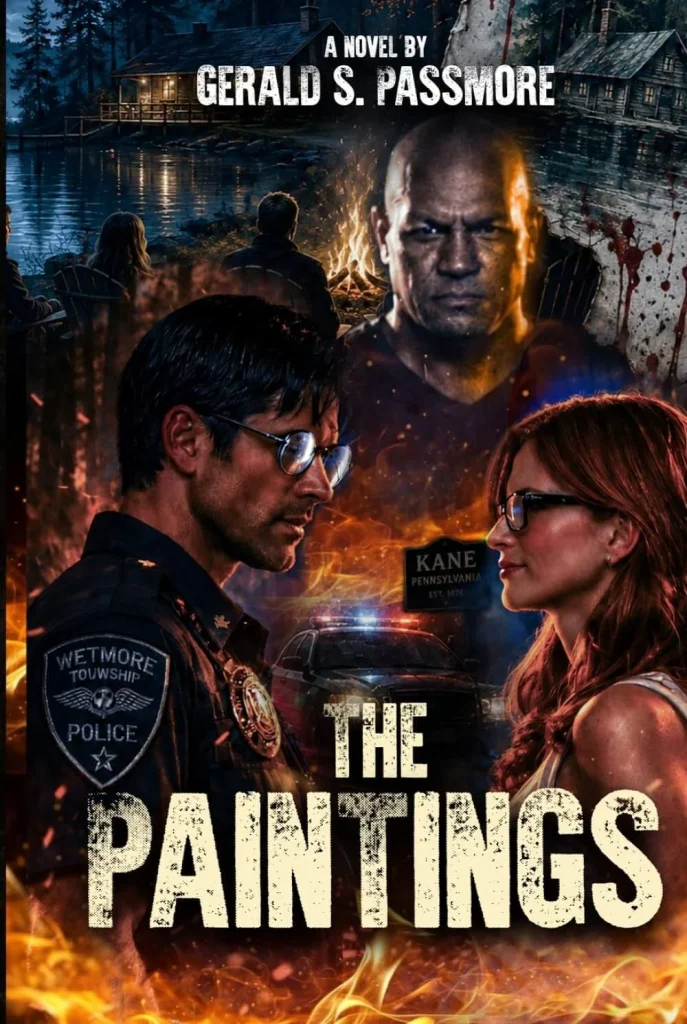
Most of The Paintings by Gerald S. Passmore takes place in real, mappable parts of Northwestern Pennsylvania: the Allegheny National Forest, the small towns of Kane, Bradford and Mt. Jewett, and Kinzua Bridge State Park, plus Pittsburgh’s Mt. Washington. This guide covers each location, what happens there in the book (without spoilers), and what you’ll find if you visit.
Content
The Allegheny National Forest
The forest is the novel’s main stage. It’s where the friends’ cabin sits on ten acres beside a cold stream, where ranger Jason Somers patrols in a custom 1985 Jeep CJ-7, and where the attack happened fifteen years before the story begins. Passmore describes it as both beautiful and isolating: old oaks and maples, low fog in the treetops, and oil pump jacks working away between the trees. Sherri, one of the survivors, says the forest “terrifies her and heals her in equal measure.”
The real place: The Allegheny National Forest is Pennsylvania’s only national forest, covering more than half a million acres across Elk, Forest, McKean and Warren counties. The oil wells are real too. The region was part of the early Pennsylvania oil boom, and active wells still dot parts of the forest. Late spring, when the book opens, and fall color season are the best times to see it.
Kane, Pennsylvania
Kane is Jason’s hometown in the book and home to the Wetmore Township Police, where Chief Warren McCord welcomes his new sergeant with a parking ticket on day one. Much of the small-town life happens here: a hardware run for cabin paint, crab cakes at a local restaurant, and long nights at Anderson’s Bar & Lounge, the book’s local watering hole, with its checkered tablecloths and a 1950s jukebox that “has about six good songs on it.”
The real place: Kane sits on US Route 6, the Grand Army of the Republic Highway, which crosses the country from Massachusetts to California. The town takes its name from General Thomas L. Kane, who raised the Civil War regiment known as the Bucktails and later settled in the area. Passmore works this history into the book.
Bradford, Pennsylvania
Bradford is Pete Barber’s hometown, and it shows up mostly in his dreams. He drifts past the ball fields where he played Little League, the Little Theater, his grandmother’s house, and the Zippo factory. Later in the book Bradford’s hospital becomes a setting too.
The real place: Bradford is the home of Zippo, the lighter maker, and of the Zippo/Case Museum. It’s also where the book’s “Bradford Black Cloud” comes from, a local nickname for the gray cloud cover that the Great Lakes push over the region. If you’re visiting, Bradford is the natural base for the forest’s northern edge.
Mt. Jewett and the Sears Catalog Cabin
The cabin at the heart of the book has a detailed backstory. According to the novel, it was built around 1924 in Mt. Jewett as a Craftsman-style house ordered from the Sears catalog for $2,400, with the original stamp still in a closet. In the early 1960s a Texas oil baron moved it into the forest, set it on a stone foundation, and built the Victorian-style outhouse out back. The friends bought it in 1994.
The real place: Sears really did sell kit houses by mail from 1908 to 1940, shipped by rail and assembled on site, and many still stand across Pennsylvania. Mt. Jewett itself is a small borough in McKean County and the closest town to Kinzua Bridge State Park.
Kinzua Bridge State Park
Kinzua Bridge plays a part in the book’s final act. We won’t say how. Read it first.
The real place: The Kinzua Viaduct was a railroad bridge built in 1882 and rebuilt in steel by 1900. At about 301 feet high and 2,053 feet long, it was once billed as the tallest railroad bridge in the world. On July 21, 2003, a tornado tore eleven of its towers from their bases. In 2011 the park opened the Kinzua Bridge Skywalk on six restored towers, with a partly glass-floored observation deck 225 feet above the gorge and the wreckage still lying in the valley below. It’s worth the trip, especially in October.
Lantz Corners and Route 219
The book’s characters spend a lot of time on Route 219 and the forest roads around Lantz Corners, where the state police are based in the story. If you drive this stretch, you’ll see why chases in this book take so long. The roads curve, the forest closes in, and the cell signal is not your friend.
Grandview Avenue, Mt. Washington, Pittsburgh
Pete and Mary live in a house on Grandview Avenue, where Pete plays guitar on a fourth-floor balcony overlooking downtown. Mary’s studio and gallery are in Pittsburgh too, which is where the paintings are made.
The real place: Grandview Avenue runs along the top of Mt. Washington, which was once called Coal Hill for the coal seam under it. The view takes in the downtown skyline and the point where the Allegheny and Monongahela rivers meet to form the Ohio. The Monongahela and Duquesne inclines still carry people up the hill.
Alexandria, Virginia
Ted and Sherri Wolowski live in an old brick colonial in the Rosemont section of Alexandria. Ted works for the EPA, and Sherri is a paralegal near the federal courthouse. Their chapters show how the night in the forest followed them hundreds of miles away.
A Simple Route for Readers Who Want to Visit
- Start in Pittsburgh with the view from Grandview Avenue.
- Drive north to Kane on Route 6 and walk Main Street.
- Head into the Allegheny National Forest on the forest roads around Kane.
- Visit Kinzua Bridge State Park and the Skywalk near Mt. Jewett.
- Finish in Bradford with the Zippo/Case Museum.
Bring the book. Or better, read it first, then go. Want more on the book itself? Read our spoiler-free review of The Paintings.
The Paintings: Book Details
| Title | The Paintings (revised edition) |
| Author | Gerald S. Passmore |
| Editor and publisher | Writers of the West |
| Publication date | June 19, 2026 (first edition 2014) |
| Genre | Psychological thriller, supernatural mystery (Amazon: Ghost Thrillers, Hard-Boiled Mystery, Ghost Mysteries) |
| Setting | Allegheny National Forest, Kane, Bradford and Pittsburgh, Pennsylvania |
| Length | 382 pages; Prologue, 54 chapters and Epilogue |
| Formats | Hardcover ($24.99), Paperback ($15.78), Kindle ($6.99, free with Kindle Unlimited) |
| ISBN-13 | 979-8182199155 |
| ASIN | B0H684RV9G |
| Language | English |
| Buy | The Paintings on Amazon |
Prices as listed on Amazon at the time of writing and may change.
Get The Paintings by Gerald S. Passmore on Amazon in hardcover, paperback or Kindle.
Frequently Asked Questions
Is the cabin in The Paintings a real place?
The cabin is fictional, but it’s based on a real type of house. Sears sold Craftsman-style kit homes by catalog until 1940, and the book’s cabin is one of them, moved from Mt. Jewett into the forest.
Is Wetmore Township real?
Yes. Wetmore Township is a real township in McKean County, next to the borough of Kane. The police department and its officers in the book are fictional.
Can you visit Kinzua Bridge?
Yes. Kinzua Bridge State Park near Mt. Jewett is open to visitors, and the Skywalk lets you walk out on the remaining towers of the original viaduct.
Which towns appear in The Paintings?
Kane, Bradford, Mt. Jewett, Lantz Corners and Warren in Pennsylvania, plus Pittsburgh and Alexandria, Virginia.
John’s the resident literary connoisseur. He dissects classics and uncovers hidden gems. Expect his insights to enrich your reading journey, one page at a time.