
There is a moment in almost every good conspiracy thriller when scattered events stop looking like coincidences.
A strange incident in one city means very little. Another somewhere else can be explained away. A third might raise an eyebrow. But eventually somebody puts the pieces next to each other and realizes they have been looking at parts of the same picture.
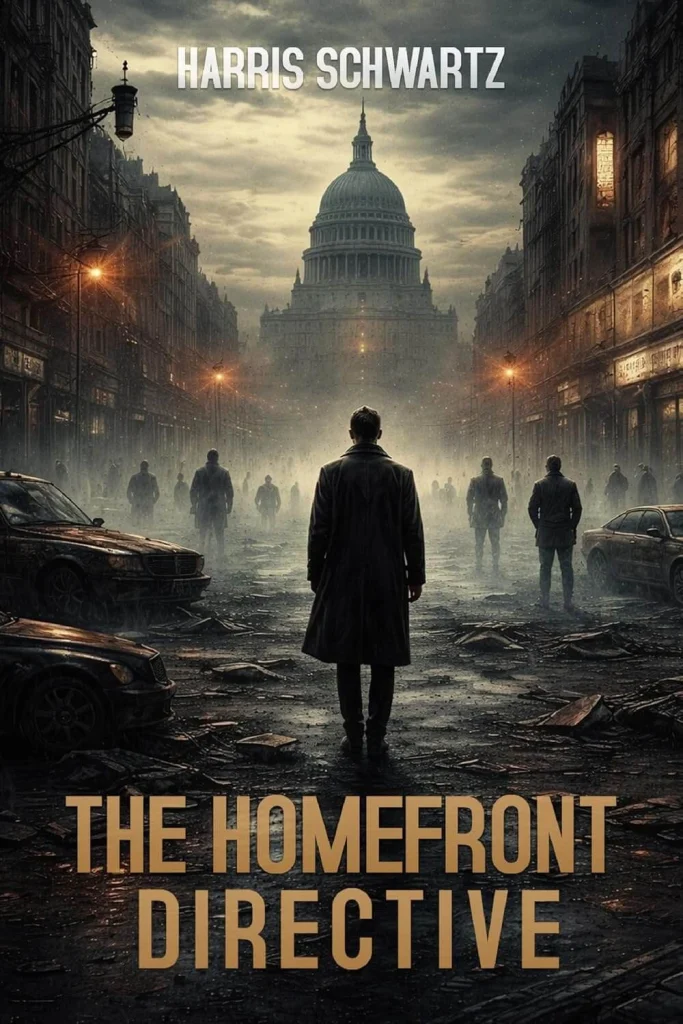
Harris Schwartz builds The Homefront Directive around that realization.
The novel begins with an unusual incident in Denver, then steadily widens its scope into something far more ambitious. At the center of it are two men who see the same institutions in very different ways.
One wants to expose their weaknesses.
The other has to figure out what he is planning before those weaknesses become something much more dangerous.
Content
A Scientist Who Lost Faith in the System
Dr. Erik Vance did not begin as a revolutionary.
He was a researcher working on advanced medical technology when he discovered that work with legitimate therapeutic potential was being pushed toward applications he believed crossed an ethical line.
Vance tried to raise the alarm.
What followed shaped the man he would become.
Rather than seeing the problem corrected, he watched the mechanisms he trusted close around it. His access was restricted, his professional life collapsed, and the evidence he had gathered became tangled in corporate and legal protections.
For Vance, this was more than a personal betrayal.
It changed how he saw the entire system.
By the time The Homefront Directive begins, he is no longer trying to convince institutions that they are failing. He wants to demonstrate it.
What Happened in Denver?
The opening operation is designed to trigger alarms within the city’s monitoring infrastructure.
That distinction is important. Vance and his people are interested in the response itself. They want to know what authorities detect, how quickly they react, what information moves between agencies, and what happens when something appears that does not fit neatly into established procedures.
Then they disappear.
In Washington, intelligence analyst Jack Rence receives an alert.
Jack has already spent months studying a strange pattern involving encrypted communications, financial activity, and groups that should not naturally fit together. Until now, there has been plenty of smoke but no clear fire.
Denver changes that.
Working alongside analyst Maya Torres, Jack begins pulling at the loose threads.
What they find suggests the incident may not be an isolated operation at all.
Seventeen Cities and One Uncomfortable Pattern
The investigation eventually uncovers anomalies across seventeen metropolitan areas.
Water systems have behaved strangely. Air monitoring systems have recorded unusual activity. Power infrastructure has produced unexplained data.
Each event has been examined separately.
That is part of the problem.
Different agencies have different responsibilities, databases, procedures, and priorities. An environmental anomaly might be examined by one organization while a biological concern goes somewhere else. When each incident is viewed alone, there is often a reasonable explanation.
When Jack and Maya begin looking at them together, the coincidences become much harder to accept.
Someone appears to have been testing the country’s ability to detect and respond to threats.
Not once.
Repeatedly.
The possibility changes everything.
If these incidents were tests, then the obvious question is what they were testing for.
A Conspiracy That Does Not Fit the Usual Labels
One of the more intriguing parts of Schwartz’s setup is the composition of the network itself.
The investigation leads toward people whose beliefs should put them on opposite sides of almost everything. The usual political and ideological categories do not adequately explain why they are connected.
Jack and Maya eventually begin considering a different possibility.
Perhaps ideology is not what connects them.
Perhaps it is disappointment.
The network draws strength from people who believe they were failed by institutions they once trusted. Scientists, whistleblowers, activists, professionals, and others may have arrived there through completely different experiences, but their grievances point them toward the same conclusion.
Vance offers them a way to see those experiences as parts of a larger problem.
That makes the threat considerably more difficult to understand.
Jack is not simply looking for an organization.
He is trying to understand a movement.
The Institutions Are Fighting the Threat and Themselves
The investigation also gives The Homefront Directive another source of tension.
The people trying to stop the network do not operate inside a perfectly coordinated machine.
Agencies have competing jurisdictions. Information is compartmentalized. Officials worry about public reaction. Different departments want control over different parts of an investigation.
Jack and Maya are racing against their adversaries, but they are also racing against the limitations of their own bureaucracy.
That creates one of the novel’s more interesting contradictions.
Vance believes institutional weaknesses justify his actions.
Jack encounters some of those weaknesses firsthand.
Yet recognizing a problem and deciding how to respond to it are two entirely different things.
The novel leaves plenty of room between those positions.
Why the Premise Works
At first glance, The Homefront Directive has many familiar elements of modern political and intelligence thrillers.
There are secret operations, classified intelligence, government agencies, scientific threats, hidden funding networks, surveillance, and an adversary whose reach is initially difficult to measure.
What gives the story its own identity is the idea tying those elements together.
Vance is not merely trying to hide from the system.
He understands how the system works.
More importantly, he understands where it does not work.
For Jack, catching him means learning to think beyond the categories and procedures he normally relies upon. Every discovery raises another question, and every apparent answer makes the scale of the operation a little larger.
The result is a thriller built around pursuit, but also around competing interpretations of trust, accountability, and institutional failure.
For Readers Who Like Their Thrillers Big
If you enjoy novels where a small incident gradually opens into a much larger conspiracy, The Homefront Directive has an immediately appealing setup.
It combines political suspense and intelligence fiction with scientific and technological elements, while giving its central antagonist a motivation more complicated than destruction or personal gain.
Most importantly, the story gives the reader something worth wondering about beyond the conspiracy itself.
How vulnerable is a society when so much of everyday life depends on systems most of us never see?
And what happens when somebody decides to find out?
The Homefront Directive is a novel by Harris Schwartz, published by Writers of the West. The manuscript identifies Schwartz as the author and Writers of the West as its publisher.
Readers looking for a new conspiracy, political, or intelligence thriller can find the book on Amazon.
Buy The Homefront Directive on Amazon
John’s the resident literary connoisseur. He dissects classics and uncovers hidden gems. Expect his insights to enrich your reading journey, one page at a time.