
There’s a quiet anxiety running through the software industry right now. Engineers are watching agents write code in minutes that would have taken them days, and some of them are wondering, reasonably, where they fit.
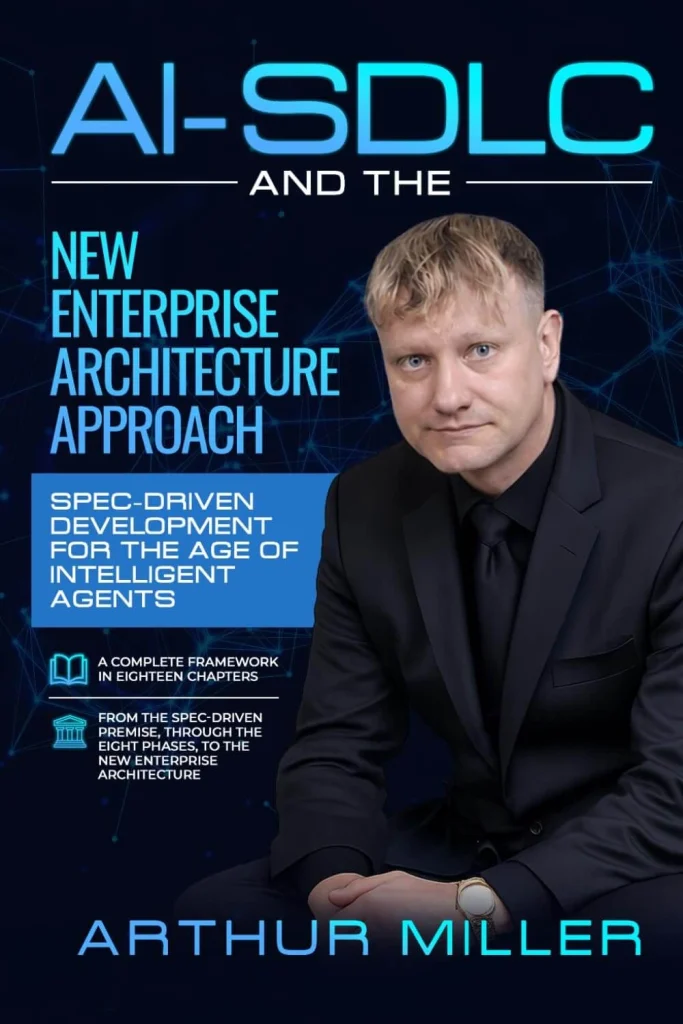
Arthur Miller’s AI-SDLC and the New Enterprise Architecture Approach is a technical book about lifecycles, specifications, and governance. But it closes on a chapter called “The Irreducibly Human,” and I think it’s the most important chapter in it.
Miller argues that when you strip software delivery down to what can’t be automated, exactly three things remain.
Judging what’s worth building. An AI can produce a plausible requirement. It can’t know whether that requirement is the right one to pursue, because that’s a judgment about value, and value lives in the business and its customers, not in any document a model can read.
Judging whether it was built right enough. Tests can be generated. What can’t be generated is the judgment of whether those tests are sufficient, whether a green dashboard means genuine confidence or hides a gap nobody thought to check.
Answering for the result. An agent can’t be called into a review, can’t bear consequences, can’t be trusted in the way accountability requires. When something fails, a person answers.
What I appreciate is that Miller doesn’t offer this as comfort. He’s careful to say these aren’t tasks AI simply hasn’t learned yet. They’re structural. A more capable model changes how much gets generated. It doesn’t change the fact that someone outside the generation has to judge and own what comes out.
Content
A framework that respects people
That idea shapes the whole book. Miller’s framework is strict about what each phase must produce and who owns it, but deliberately silent about how teams do the work inside each phase. It guides without dictating. Teams stay free to adjust, improve, and adopt new tools, because the framework only governs the handoffs.
It also reflects who wrote it. Miller has spent his career on large, regulated systems where errors hurt real people, from defense applications to national payment infrastructure. He describes his leadership approach as servant leadership grounded in ethics, and it shows.
If you lead a team through this transition, or you’re an engineer trying to see where your judgment matters most, this book gives you a clear, grounded answer.
Find AI-SDLC and the New Enterprise Architecture Approach on Amazon.
Published by Writers of the West.
John’s the resident literary connoisseur. He dissects classics and uncovers hidden gems. Expect his insights to enrich your reading journey, one page at a time.